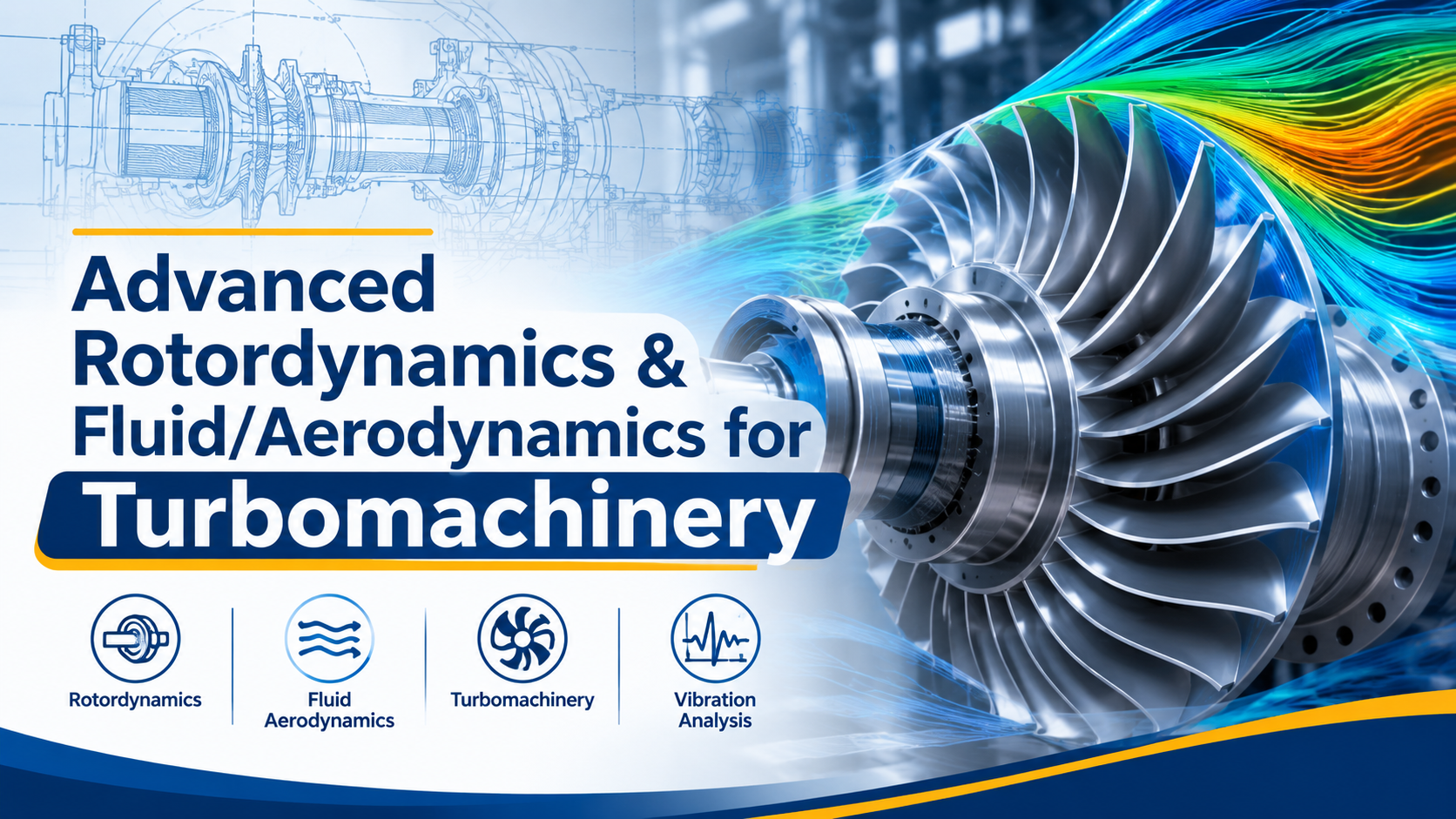

Advanced Rotordynamics & Fluid/Aerodynamics for Turbomachinery
Course Description
This advanced technical training course provides participants with in-depth knowledge of rotordynamic behavior, fluid dynamics, and aerodynamic performance of turbomachinery used in the oil and gas industry. The course focuses on advanced rotor-bearing system analysis, vibration characteristics, critical speeds, rotor stability, fluid-film bearing dynamics, seal performance, aerodynamic forces, and compressor operating behavior. Particular emphasis is placed on understanding the interaction between mechanical and aerodynamic phenomena and their influence on the reliability, efficiency, and operational stability of high-speed rotating equipment. The course also addresses advanced troubleshooting approaches, engineering assessment methods, and relevant international standards for turbomachinery design, operation, and performance evaluation.
The Training Course Will Highlight ?

Expected Outcomes

Participants will develop advanced technical competencies in evaluating the dynamic and aerodynamic performance of turbomachinery, understanding rotor-bearing interactions, identifying instability mechanisms, assessing compressor performance, and improving the reliability and operational efficiency of critical rotating equipment in oil and gas facilities.

Training Objective

By the end of the course, participants will be able to:

  • Understand advanced rotordynamic principles and rotor-bearing interactions.
  • Analyze rotor vibration behavior and identify critical speeds.
  • Evaluate lateral and torsional rotor dynamics.
  • Understand rotor stability and subsynchronous vibration mechanisms.
  • Assess fluid-film bearing characteristics and dynamic coefficients.
  • Evaluate the influence of seals and aerodynamic forces on rotor stability.
  • Understand the aerodynamic behavior of centrifugal and axial compressors.
  • Identify compressor surge, stall, and performance limitations.
  • Interpret rotordynamic and aerodynamic analysis results.
  • Apply relevant API and international engineering standards.
  • Improve troubleshooting and reliability assessment of turbomachinery.

Target Audience

  • Rotating Equipment Engineers.
  • Senior Mechanical Engineers.
  • Machinery and Reliability Engineers.
  • Turbomachinery Specialists.
  • Compressor and Gas Turbine Engineers.
  • Vibration and Condition Monitoring Engineers.
  • Maintenance and Technical Support Engineers.
  • Engineering and Asset Integrity Professionals.

Training Methods

  • Expert-led advanced technical presentations.
  • Engineering calculations and analytical examples.
  • Rotor-bearing system analysis exercises.
  • Compressor aerodynamic performance case studies.
  • Vibration and dynamic stability assessment.
  • Interpretation of engineering analysis results.
  • Industrial troubleshooting scenarios.
  • Integrated technical case studies.

Daily Agenda

Day 1: Advanced Rotordynamics and Rotor-Bearing Systems

  • Advanced Principles of Rotordynamics.
  • Dynamic Behavior of Rotating Machinery.
  • Rigid and Flexible Rotor Systems.
  • Rotor-Bearing System Modeling.
  • Lateral and Torsional Rotor Vibrations.
  • Natural Frequencies and Mode Shapes.
  • Critical Speeds and Campbell Diagrams.
  • Gyroscopic Effects and Rotor Asymmetry.
  • Unbalance Response and Rotor Balancing.
  • Damped and Undamped Rotor Response.
  • Rotor Stability and Dynamic Behavior.
  • Rotordynamic Analysis Techniques.

Day 2: Fluid-Film Bearings, Seals and Rotor Stability

  • Fundamentals of Fluid-Film Bearing Technology.
  • Hydrodynamic Journal Bearings.
  • Tilting Pad and Fixed Geometry Bearings.
  • Thrust Bearings and Their Applications.
  • Bearing Stiffness and Damping Coefficients.
  • Reynolds Equation and Fluid-Film Pressure Distribution.
  • Bearing Dynamic Characteristics.
  • Oil Whirl and Oil Whip Phenomena.
  • Bearing Instability and Subsynchronous Vibrations.
  • Labyrinth Seals and Dry Gas Seals.
  • Seal Dynamic Coefficients and Cross-Coupled Forces.
  • Aerodynamic Cross-Coupling and Rotor Stability.
  • Squeeze Film Dampers and Vibration Control.

Day 3: Advanced Fluid Dynamics and Turbomachinery Aerodynamics

  • Fundamentals of Fluid Dynamics in Turbomachinery.
  • Thermodynamic and Aerodynamic Principles.
  • Gas Flow Through Rotating and Stationary Blade Rows.
  • Centrifugal and Axial Compressor Aerodynamics.
  • Impeller and Diffuser Flow Characteristics.
  • Velocity Triangles and Energy Transfer.
  • Pressure Ratio, Head, and Efficiency.
  • Compressible Flow and Mach Number Effects.
  • Flow Separation and Secondary Flow.
  • Boundary Layers and Tip Clearance Losses.
  • Aerodynamic Forces Acting on Rotating Components.
  • Blade Loading and Flow-Induced Excitation.
  • Aerodynamic Performance Evaluation.

Day 4: Compressor Performance, Dynamic Stability and Operational Problems

  • Centrifugal Compressor Performance Characteristics.
  • Compressor Maps and Operating Envelopes.
  • Compressor Surge and Rotating Stall.
  • Flow Instability and Aerodynamic Excitation.
  • Effects of Gas Composition and Operating Conditions.
  • Compressor Performance Degradation.
  • Interaction Between Rotor Dynamics and Aerodynamic Forces.
  • Performance Limitations and Operating Constraints.
  • Dynamic Response During Start-Up and Shutdown.
  • Vibration Analysis and Diagnostic Techniques.
  • Aerodynamic and Mechanical Failure Mechanisms.
  • Troubleshooting of High-Speed Turbomachinery.

Day 5: Advanced Analysis, Standards and Reliability Applications

  • Integrated Rotor-Bearing-Aerodynamic System Analysis.
  • Rotor Dynamic Stability Assessment.
  • Critical Speed and Unbalance Response Evaluation.
  • Bearing and Seal Performance Assessment.
  • Torsional Vibration and Train Dynamics.
  • Application of Finite Element Analysis (FEA).
  • Introduction to Computational Fluid Dynamics (CFD) for Turbomachinery.
  • Rotordynamic Design and Evaluation Requirements.
  • API 617: Axial and Centrifugal Compressors.
  • API 684: Rotordynamic Tutorials and Related Engineering Principles.
  • ASME PTC 10: Performance Test Code for Compressors.
  • Engineering Design Reviews and Technical Assurance.
  • Integrated Case Study: Rotordynamic and Aerodynamic Assessment of an Industrial Centrifugal Compressor.
  • Final Technical Assessment and Discussion.
Accreditation

CDGA completion certificate will be issued to all attendees completing minimum of 80 % of the total course duration.

Quick Enquiry

Request Info

Download Brochure Request In house Proposal

Course Rounds : (5 -Days)


Code Date Venue Fees Register
ME191-01 29-03-2027 Istanbul USD 5950
ME191-02 05-07-2027 Dubai USD 5450
ME191-03 16-08-2027 Istanbul USD 5950
ME191-04 19-12-2027 Dubai USD 5450
Prices doesn't include VAT

UpComing Date


Details
  • Start date 29-03-2027
  • End date 02-04-2027

Venue
  • Country Turkey
  • Venue Istanbul

Quality Policy

 Providing services with a high quality that are satisfying the requirements
 Appling the specifications and legalizations to ensure the quality of service.
 Best utilization of resources for continually improving the business activities.

Technical Team

CDGA keen to selects highly technical instructors based on professional field experience

Strengths and capabilities

Since CDGA was established, it considered a training partner for world class oil & gas institution

Search For Available Course

Ireland, Ireland

3012, Block 3, 30 Euro Business Park, Little Island, Co. Cork, T45 V220, Ireland

+353 214 552955

Mon to Fri 09:00 AM to 06:00 PM

Info@cdga-training.com

Contact Us anytime!