
You Will Learn to:
Piping engineers and designers, fabricators and erectors, QA/QC personnel, engineers and maintenance personnel who desire a more in depth understanding of the Fabrication and Examination rules of the ASME Codes & Standards, operation, mechanical and maintenance personnel, inspection and quality personnel responsible for specifying, operating, inspecting and maintaining piping systems, code compliance personnel, regulatory personnel, consulting engineers, design engineers, maintenance engineers, project engineers, maintenance personnel, service engineers, planners and schedulers, M & E foremen, technical assistants & coordinators & technicians, public safety officials, and government regulators
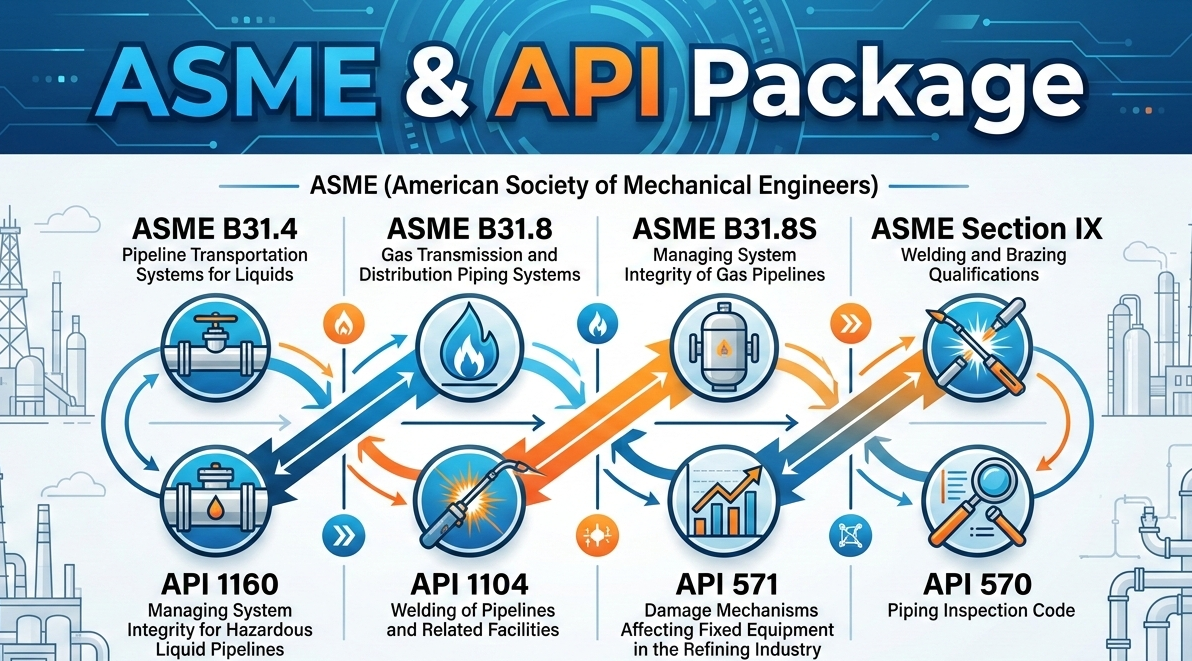
Part 1 ASME B31.4 Pipeline Transportation Systems for Liquid Hydrocarbons and Other Liquids
Course content
• Scope and definitions
• Design
• What is surge?
• Head loss and hydraulic design
• Pipeline size considerations
• Curved pipe, fittings, and flanges
• Longitudinal stress
• Stresses in buried pipelines
• Material Selection
• The difference between strength and toughness
• Ductile and brittle fracture
• How toughness is measured
• Line pipe materials and their characteristics
• Line pipe toughness specification
• How fittings and flanges are selected
• Construction Welding and Assembly
• Care and handling of line pipe
• Bending of pipe
• Welding procedure specifications
• Welder qualification
• Welded joint design and fit-up considerations Welding problems
• Requirements for tanks, terminals, pump stations, and special components
• Hydrostatic Testing
• History of the hydrostatic test
• Test-pressure-to-operating-pressure ratio
• Hold-time/leak test
• Pressure reversals
• Optimum tests for new pipe
• Optimum tests for revalidating existing pipelines
• Operations, Maintenance, and Corrosion Control
• Requirements for operating and maintaining a pipeline
• Defect assessment
• Pipeline repair methods
• Remaining life assessment
• Requirements for corrosion control
• API Recommended Practice 1160 (RP 1160), Managing System Integrity for Hazardous Liquid Pipelines,
Part 2 ASME B31.8 Gas Transmission & Distribution Piping Systems
ASME B31.8 is the most widely used Code for the design, operation, maintenance, and repair of natural gas distribution and transmission pipelines. This course explains the present-day piping Code provisions, the principal intentions of the Code, and how the Code should be used. The emphasis is primarily on transmission pipelines.
Course content
• Introduction
• Materials
• Welding
• Fittings, Longitudinal Stresses, Flexibility
• Pressure Design
• Fracture Control, Construction, Testing
• Corrosion
• Remaining Strength of Corroded Pipe
• Pipeline Repairs
• Sour Gas Pipelines
• Appendices
• 8-S – Managing System Integrity of Gas Pipelines
Part 3 - Pipeline welding and welding qualifications requirement
• API 1104 welding of pipeline and related facilities
• Scope
• Terms, Definitions, Acronyms, and Abbreviations
• Qualification of Welding Procedures with Filler Metal Additions
• Procedure Qualification
• Record
• Welding Procedure Specification
• Testing of Welded Joints—Butt Welds
• Qualification of Welders
• Single Qualification
• Multiple Qualification
• Nondestructive Testing (NDT)—Butt Welds Only
• Design and Preparation of a Joint for Production Welding
• Use of Lineup Clamp for Butt Welds.
• Position Welding
• Preheat and PWHT
• Inspection and Testing of Production Welds
• Rights of Inspection
• Methods of Inspection
• Qualification of Inspection Personnel
• Certification of NDT Personnel
• Acceptance Standards for NDT
• Rights of Rejection.
• Radiographic Testing
• Magnetic Particle Testing
• Liquid Penetrant Testing
• Ultrasonic Testing.
• Visual Acceptance Standards for Undercutting.
• Repair and Removal of Weld Defects
• Authorization for Repair.
• Repair Procedure
• Acceptance Criteria
• Procedures for NDT
BPVC Section IX-Welding, Brazing, and Fusing Qualifications
• Article I: General Requirements.
• Article II: Welding Procedure Qualification.
• Article III: Welding Performance Qualifications.
• Article IV: Welding Data.
• Writing a Welding Procedure.
• Welder's Qualification.
• Review of WPS and PQR (Practice Cases).
• Review API Exam question related to ASME IX
API 571 Damage Mechanisms Affecting Fixed Equipment in the Refining Industry
• Introdction to API 571 organization and required Definitions
• Discuss the following damage mechanisms (related to API 570 exam)
• 3 Amine Stress Corrosion Cracking
• 8 Atmospheric Corrosion
• 9 Boiler Water and Stream Condensate Corrosion
• 14 Caustic Corrosion
• 15 Caustic Stress Corrosion Cracking
• 17 Chloride Stress Corrosion Cracking
• 22 Corrosion Under Insulation
• 27 Erosion/Erosion – Corrosion
• 31 Galvanic Corrosion
• 37 Hydrochloric Acid Corrosion
• 43 Mechanical Fatigue (Including Vibration-induced Fatigue)
• 45 Microbiologically Influenced Corrosion
• 57 Soil Corrosion
• 58 Sour Water Corrosion (Acidic)
• 61 Sulfidation
API 570 – Piping Inspection Code: In-service Inspection, Rating, Repair, and Alteration of Piping Systems
• Scope & General Application.
• Fitness-For-Service (FFS) and Risk-Based Inspection (RBI)
• Terms, Definitions, Acronyms, and Abbreviations
• Owner/User Inspection Organization
• Inspection, Examination, and Pressure Testing Practices.
• Interval/Frequency and Extent of Inspection
• Inspection Data Evaluation, Analysis, and Recording
• Repairs, Alterations, and Rerating of Piping Systems
• Inspection of Buried Piping
• Annex A (informative) Inspector Certification
• Annex B (informative) Requests for Interpretations
• Annex C (informative) Examples of Repairs
• Annex D (informative) Two Examples of the Calculation of MAWP Illustrating the Use of the Corrosion Half-life Concept
• Review API Exam question
CDGA attendance certificate will be issued to all attendees completing minimum of 80% of the total course duration.
| Code | Date | Venue | Fees | Register |
|---|---|---|---|---|
| PE231-05 | 08-11-2026 | Doha | USD 5450 | |
| PE231-01 | 04-01-2027 | Kuala-Lumpur | USD 5950 | |
| PE231-02 | 10-05-2027 | London | USD 6950 | |
| PE231-03 | 15-08-2027 | Cairo | USD 5450 | |
| PE231-04 | 26-12-2027 | Jeddah | USD 5450 |
Providing services with a high quality that are satisfying the requirements
Appling the specifications and legalizations to ensure the quality of service.
Best utilization of resources for continually improving the business activities.
CDGA keen to selects highly technical instructors based on professional field experience
Since CDGA was established, it considered a training partner for world class oil & gas institution
3012, Block 3, 30 Euro Business Park, Little Island, Co. Cork, T45 V220, Ireland
Mon to Fri 09:00 AM to 06:00 PM
Contact Us anytime!
Request Info