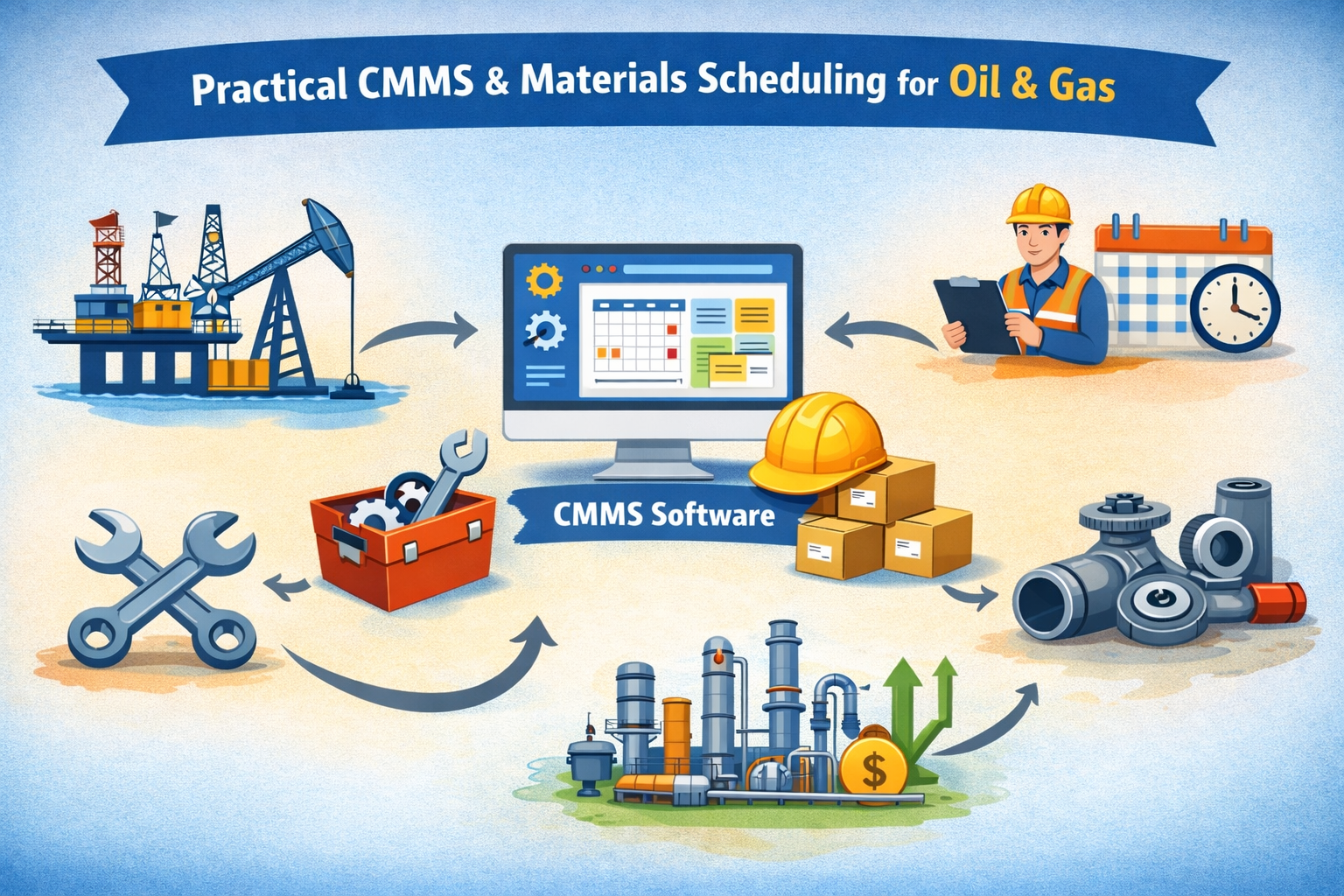

Practical CMMS & Materials scheduling for oil & gas
Course Description
Oil & Gas organizations rely on high equipment availability, safe operations, and disciplined cost control. A robust CMMS/EAM process—paired with effective materials planning & scheduling—is the backbone for delivering reliable production, compliant maintenance, and optimized inventory. This course moves beyond theory to hands on, practical methods for building an integrated planning, scheduling, and materials pipeline—linking work identification → prioritization → planning → materials readiness → scheduling → execution → close out → analytics/KPIs. Participants will practice with real world data structures (functional locations, equipment masters, BOMs), planning standards (task lists, labor norms, estimate libraries), parts strategies (critical spares, MRP, min max), and schedule governance (90 day frozen windows, weekly scheduling, daily control). We emphasize safe work, compliance, and value realization through measurable KPIs. Participants will practice with real world data structures (functional locations, equipment masters, BOMs), planning standards (task lists, labor norms, estimate libraries), parts strategies (critical spares, MRP, min max), and schedule governance (90 day frozen windows, weekly scheduling, daily control). We emphasize safe work, compliance, and value realization through measurable KPIs.
The Training Course Will Highlight ?

Assessment & Certification

  • Formative assessments after each module (quizzes, quick practical checks)
  • Capstone evaluation (rubric‑based on completeness, realism, and KPI alignment)
  • Certificate of Completion (70% overall threshold recommended)
Training Objective

By the end of the course, participants will be able to:

  1. Design a CMMS workflow for corrective, preventive, predictive, and shutdown work that drives data quality and reliable execution.
  2. Build maintainable plans (task lists, work packs, estimates) with accurate labor, duration, tools, permits, and QA/QC.
  3. Integrate materials: create and maintain BOMs, set MRP & stocking policies, and align procurement lead times with the schedule.
  4. Run the planning & scheduling cycle (90‑day look‑ahead → weekly schedule → daily control) with gates for “Ready to Schedule.”
  5. Manage Turnarounds/Shutdowns (STO): scope control, materials staging, risk registers, critical path, and readiness reviews.
  6. Use KPIs and dashboards (Schedule Compliance, Planning Backlog, OTIF materials, Cost vs Budget, Wrench‑time) to drive continuous improvement.
  7. Govern master data (criticality, coding standards, naming conventions) and close the loop with failure coding and root‑cause learning.
  8. Map your current state and design a pragmatic improvement roadmap (90‑day/6‑month plan).

Target Audience

  • Maintenance Planners, Schedulers, Supervisors, and Execution Leads
  • Warehouse/Materials & Inventory Controllers, Procurement Specialists, MRO Buyers
  • Reliability Engineers, Rotating/Static Equipment Engineers, Integrity Engineers
  • CMMS/EAM Analysts, Data Stewards, Master‑Data Teams, IT/OT integrators
  • Production Coordinators and Operations Team Leaders
  • Turnaround/Shutdown Managers and Coordinators
  • HSE & QA/QC personnel involved in work preparation and permits

Prerequisites: Basic familiarity with maintenance processes or CMMS usage is helpful but not mandatory.

Training Methods

  • Interactive Workshops: short lectures → guided demos → hands on exercises → reviews.
  • Case Studies: upstream (offshore FPSO), midstream (pipeline stations), downstream (refinery).
  • Job Aids & Templates: planning checklist, work pack template, materials readiness checklist, BOM/MRP setup guide, weekly schedule board, KPI pack.
  • Capstone: build a mini integrated plan & schedule with materials, then present an improvement roadmap.

Daily Agenda

Note: Timings are indicative (e.g., 08:30–16:30) with two short breaks and a lunch break.

Day 1 — CMMS Foundations & Planning Standards

Learning Focus: process flow, roles, data structures, planning quality.

  • Module 1: O\&G Maintenance Operating System
  • Work types (PM/CM/EM/Project/STO), RACI, workflows, approvals, safety barriers, permits
  • Backlog taxonomy: safety/production/defect/inspection; prioritization matrices (Risk, Criticality)
  • Module 2: Master Data Essentials
  • Functional Locations vs Equipment, hierarchy best practices
  • Criticality Analysis (HSE/production/quality/environment/maintainability)
  • Failure codes, cause codes, notification types; coding rules & data governance
  • Module 3: Planning Excellence 
  • Task lists/Job plans; estimating labor/duration; tools & lifting plans; QA/QC & hold points
  • Work Pack structure (scope, hazards, JSA, permits, parts, drawings, isolation plan)
  • Workshop 1: Build a standard task list and a work pack using provided templates
  • Quick Wins: planning checklist; definition of “Ready to Plan

Deliverables: Planning checklist, Task List template, Work Pack template.

Day 2 — Materials Management & MRP for Maintenance

Learning Focus: connect CMMS with Stores/Procurement; ensure right parts at right time.

  • Module 4: BOMs & Spares Strategy
  • Creating accurate Equipment BOMs, linking drawings/OEM manuals
  • Identifying critical spares (long lead, safety/system critical)
  • Repairable vs consumable, interchangeability, alternate items
  • Module 5: Inventory Policies & MRP
  • Min‑Max vs MRP, reorder points, safety stock, EOQ (conceptual)
  • Lead times (supplier, transport, customs, QA); vendor managed inventory (VMI) basics
  • Stock vs non‑stock decisions; rotables & kitting; preservation requirements
  • Module 6: Materials Readiness Gates
  • “Ready to Schedule” criteria (materials, permits, access, resources)
  • Reservation vs purchase requisition; expediting & tracking; OTIF (On‑Time‑In‑Full)
  • Workshop 2: Build an Equipment BOM, set min‑max/MRP parameters, and prepare a pick‑list & kit
  • Quick Wins: materials readiness checklist; critical spare review cadence

Deliverables: BOM template, Materials Readiness checklist, Kitting template.

Day 3 — Integrated Planning & Scheduling Cycle

Learning Focus: 90‑day look‑ahead, weekly schedule, daily control, frozen windows.

  • Module 7: Demand Shaping & Look‑Ahead
    • 13‑week (90‑day) plan, outage windows, permits/isolations, campaign maintenance
    • Bundling by location/permit, opportunistic work (e.g., planned downtime)
  • Module 8: Weekly Scheduling & Leveling
  • Capacity planning (crafts, contractors, special tools), leveling, constraints board
  • Schedule Compliance (PSC/SSC), break‑in work policy, frozen zone discipline
  • Module 9: Execution Control & Close‑out
    • Daily readiness meeting, job status codes, delay capture (access/materials/permit)
    • Technical completion, time confirmations, failure coding, document attachment
  • Workshop 3: Build a 90‑day look‑ahead and a resource‑leveled weekly schedule; run a daily control simulation
  • Quick Wins: standard weekly cadence (GMPS: Gate, Meet, Plan, Schedule), visual boards

Deliverables: 90‑Day Look‑Ahead template, Weekly Schedule board (Excel/Gantt), Daily Control board.

Day 4 — Turnarounds/Shutdowns (STO) & Contractor Integration

Learning Focus: scope control, critical path, readiness, and material staging for STO.

  • Module 10: STO Lifecycle
  • Scope challenge/freeze, WBS & coding, critical path method (CPM), risk register
  • Long‑lead procurement, staging & laydown, QA/QC & test packs, punch lists
  • Module 11: Contractor & Vendor Management
  • Contracting strategies (LSTK, unit‑rate, T\&M), performance KPIs, onboarding & safety
  • Workface planning, permit integration, shift turnover standards
  • Module 12: Assurance & Readiness Reviews
  • Readiness gates (30/60/90%), materials & scaffolding readiness, logistics plans
  • Post‑execution review: variance analysis (scope, cost, duration), lessons learned
  • Workshop 4: Build a mini turnaround plan with materials staging and a critical path fragment
  • Quick Wins: STO dashboard (scope stability, materials OTIF, test pack completion)

Deliverables: STO Readiness checklist, Materials Staging plan, Risk Register template.

Day 5 — Performance, Analytics & Implementation Roadmap

Learning Focus: KPIs, dashboards, continuous improvement, and your 90‑day action plan.

  • Module 13: KPI Suite & Data Quality
  • Planning: % Work Planned, Planning Backlog Age, Rework Rate
  • Scheduling: Schedule Compliance (PSC/SSC), Break‑in %, Wrench‑time
  • Materials: OTIF, Stock‑outs, Excess & Obsolescence, Inventory Turnover, Service Level
  • Cost: Maintenance Cost per BOE/throughput, Labor productivity
  • Data quality audits (masters, BOM coverage, duplicate parts, failure coding completeness)
  • Module 14: Reliability Integration
  • Linking CMMS to RCM/FMEA, PdM routes, condition monitoring & work triggers
  • Bad actor analysis; RCA feedback loop to task lists & materials strategy
  • Module 15: Roadmapping & Change Management
  • Current‑state assessment: maturity scan (process, data, tools, people)
  • Prioritized backlog of improvements (no/low‑cost vs system changes)
  • Governance: roles, cadence, and steering indicators
  • Capstone Workshop: Teams build an integrated improvement roadmap + KPI dashboard mockup; final presentations & peer review
  • Course Wrap‑Up: Individual action plans, success criteria, coaching schedule

Deliverables: KPI pack (definitions + formulas), Data Quality audit checklist, 90‑Day Roadmap template, Personal Action Plan.

Accreditation

 CDGA attendance certificate will be issued to all attendees completing minimum of 80% of the total course duration.

Quick Enquiry

Request Info

Download Brochure Request In house Proposal

Course Rounds : (5 -Days)


Code Date Venue Fees Register
MI272-01 29-03-2026 Muscat USD 5450
MI272-02 07-06-2026 Riyadh USD 5450
MI272-03 05-07-2026 Cairo USD 5450
MI272-04 05-10-2026 London USD 6950
Prices doesn't include VAT

UpComing Date


Details
  • Start date 29-03-2026
  • End date 02-04-2026

Venue
  • Country Oman
  • Venue Muscat

Quality Policy

 Providing services with a high quality that are satisfying the requirements
 Appling the specifications and legalizations to ensure the quality of service.
 Best utilization of resources for continually improving the business activities.

Technical Team

CDGA keen to selects highly technical instructors based on professional field experience

Strengths and capabilities

Since CDGA was established, it considered a training partner for world class oil & gas institution

Search For Available Course

Ireland, Ireland

3012, Block 3, 30 Euro Business Park, Little Island, Co. Cork, T45 V220, Ireland

+353 214 552955

Mon to Fri 09:00 AM to 06:00 PM

Info@cdga-training.com

Contact Us anytime!