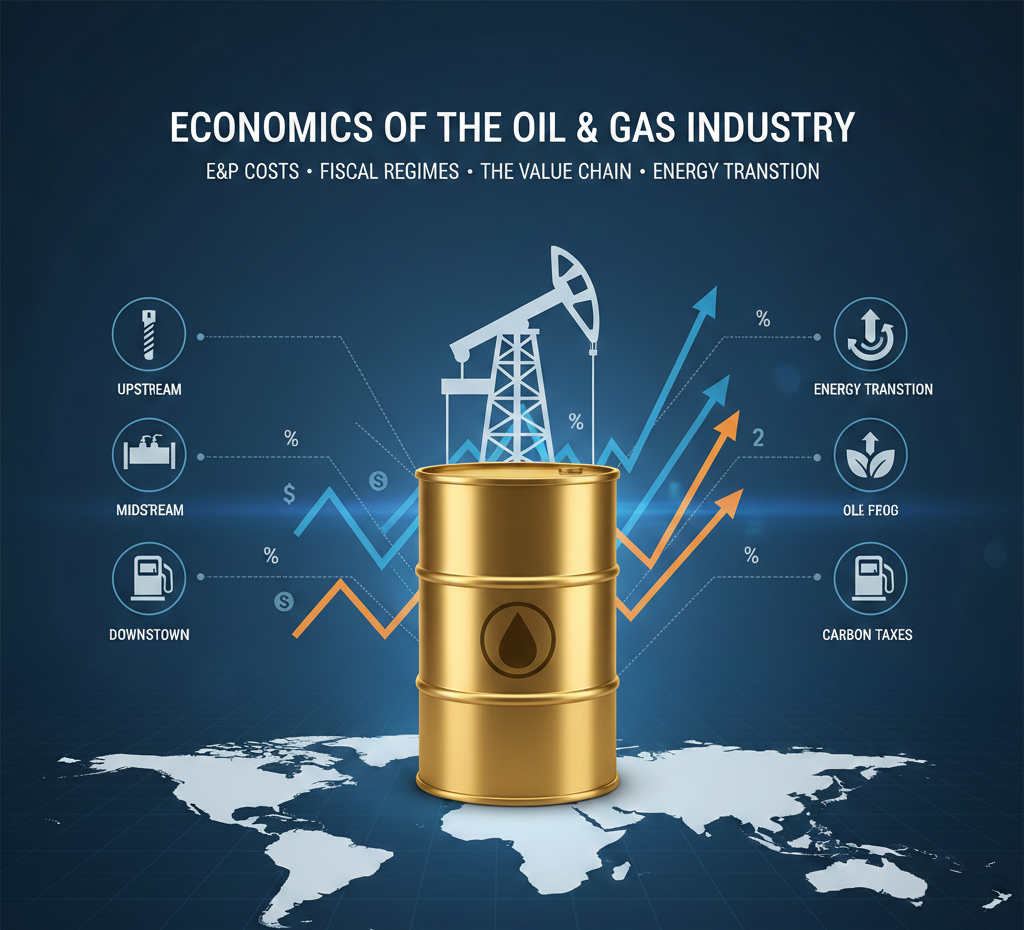

Economics of the Oil & Gas Industry
Course Description
The global oil and gas sector is a highly competitive, high risk, capital intensive industry. Success requires a deep understanding of the value chain—from exploration to refining and marketing—as well as the economic principles that guide investment decisions. This course provides a structured overview of economic evaluation tools including cost structures, revenue modeling, risk assessment, and financial indicators such as Net Present Value (NPV) and Internal Rate of Return (IRR). Participants will gain a comprehensive understanding of how decisions are made, how value is created, and how risks are managed in upstream, midstream, and downstream operations.
The Training Course Will Highlight ?
Training Objective

By the end of this program, participants will be able to:

Industry & Value Chain Understanding

  • Understand the end‑to‑end oil & gas value chain and how value is generated in each segment.
  • Identify major cost drivers, revenue streams, and commercial structures across the chain.

Economic Evaluation

  • Build and interpret discounted cash‑flow (DCF) models.
  • Apply NPV, IRR, Payback, and Economic Limit calculations.
  • Understand capital allocation, screening criteria, and project ranking.

Cost & Revenue Analysis

  • Break down CAPEX, OPEX, variable costs, fixed costs, and lifecycle economics.
  • Understand refinery margins, gas pricing, transportation tariffs, and product netbacks.

Risk & Uncertainty

  • Conduct sensitivity testing for key uncertainties.
  • Recognize market, operational, and financial risks affecting project value.

Strategic Perspective

  • Understand how economics influence portfolio decisions, contracting, negotiations, and long‑term strategy.

Target Audience

This course is designed for:

  • Engineers (reservoir, process, production, drilling, facilities)
  • Economists & planners
  • Finance, accounting, and budgeting professionals
  • Business development & strategy teams
  • Contracts & commercial specialists
  • Government & regulatory staff
  • Investors, analysts, and consultants working in the energy sector

No advanced mathematical background is needed; concepts are taught clearly and practically.

Training Methods

  • Instructor‑led presentations with real industry examples
  • Interactive discussions and problem‑solving sessions
  • Group exercises simulating real project decisions
  • Hands‑on financial modelling using basic Excel
  • Case studies from upstream, LNG, pipelines, refining, and petrochemicals
  • Daily short quizzes to reinforce learning
  • Downloadable templates: DCF model, NPV/IRR calculator, cost breakdown sheets

Daily Agenda

DAY 1 – Foundations of the Oil & Gas Industry & Value Creation

Morning

  • Overview of the global energy landscape
  • The Oil & Gas value chain: upstream, midstream, downstream
  • Where and how value is created along the chain
  • Cost structure overview: capital intensity and lifecycle economics

Afternoon

  • Types of costs: exploration, development, production, refining, transportation
  • Revenue formation: oil pricing, gas pricing, product pricing
  • Introduction to project economics: cash‑flow concepts
  • Group Exercise: Build a simple value chain map for an oil field


DAY 2 – Upstream Economics, Costs & Revenues

Morning

  • Exploration economics & risked vs. unrisked value
  • Upstream cost structure (CAPEX, OPEX, abandonment, tariffs)
  • Production profiles and their economic impact
  • Fiscal systems (royalty/tax, PSC, service contracts)

Afternoon

  • Building an upstream cash‑flow model
  • Calculating unit technical cost, netbacks, and economic limit
  • Exercise: Estimate the breakeven price for a sample field
  • Case Study: Comparing two fiscal regimes


DAY 3 – Midstream & Downstream Economics

Morning – Midstream

  • Pipelines, storage, LNG, and gas processing economics
  • Tariffs, tolling fees, capacity utilization
  • Gas market principles: contracts, indexation, netbacks

Afternoon – Downstream

  • Refining economics: crude slate, yields, and margin drivers
  • Petrochemical chains and integration value
  • Transportation & marketing economics
  • Exercise: Estimate refinery margin under different price scenarios

DAY 4 – Economic Evaluation Tools: NPV, IRR & Risk Analysis

Morning

  • Time value of money
  • Discount factors and cash‑flow discounting
  • Calculating NPV and IRR (hands‑on practice)
  • Interpretation and pitfalls of IRR

Afternoon

  • Sensitivity analysis: price, cost, production, delays
  • Scenario analysis: optimistic, base, pessimistic
  • Introduction to risk and uncertainty in project evaluation
  • Exercise: Assess uncertainty impacts on IRR

DAY 5 – Integrating Economics into Real Business Decisions

Morning

  • Capital budgeting & portfolio management
  • Screening criteria for oil & gas projects
  • Commercial negotiations and value drivers
  • Financing options and their impact on project economics

Afternoon

  • Capstone Project: Evaluate a full oil & gas opportunity
    • Build a DCF model
    • Calculate NPV, IRR
    • Conduct sensitivity analysis
    • Present findings to an investment committee
  • Course Review & Q\&A

Certification & Closing Remarks

Accreditation

CDGA attendance certificate will be issued to all attendees completing minimum of 80% of the total course duration.

Quick Enquiry

Request Info

Download Brochure Request In house Proposal

Course Rounds : (5 -Days)


Code Date Venue Fees Register
ACC186-01 06-04-2026 London USD 6950
ACC186-02 03-08-2026 Dubai USD 5450
ACC186-03 28-09-2026 Istanbul USD 5950
ACC186-04 08-11-2026 Cairo USD 5450
Prices doesn't include VAT

UpComing Date


Details
  • Start date 06-04-2026
  • End date 10-04-2026

Venue
  • Country United Kingdom
  • Venue London

Quality Policy

 Providing services with a high quality that are satisfying the requirements
 Appling the specifications and legalizations to ensure the quality of service.
 Best utilization of resources for continually improving the business activities.

Technical Team

CDGA keen to selects highly technical instructors based on professional field experience

Strengths and capabilities

Since CDGA was established, it considered a training partner for world class oil & gas institution

Search For Available Course

Ireland, Ireland

3012, Block 3, 30 Euro Business Park, Little Island, Co. Cork, T45 V220, Ireland

+353 214 552955

Mon to Fri 09:00 AM to 06:00 PM

Info@cdga-training.com

Contact Us anytime!