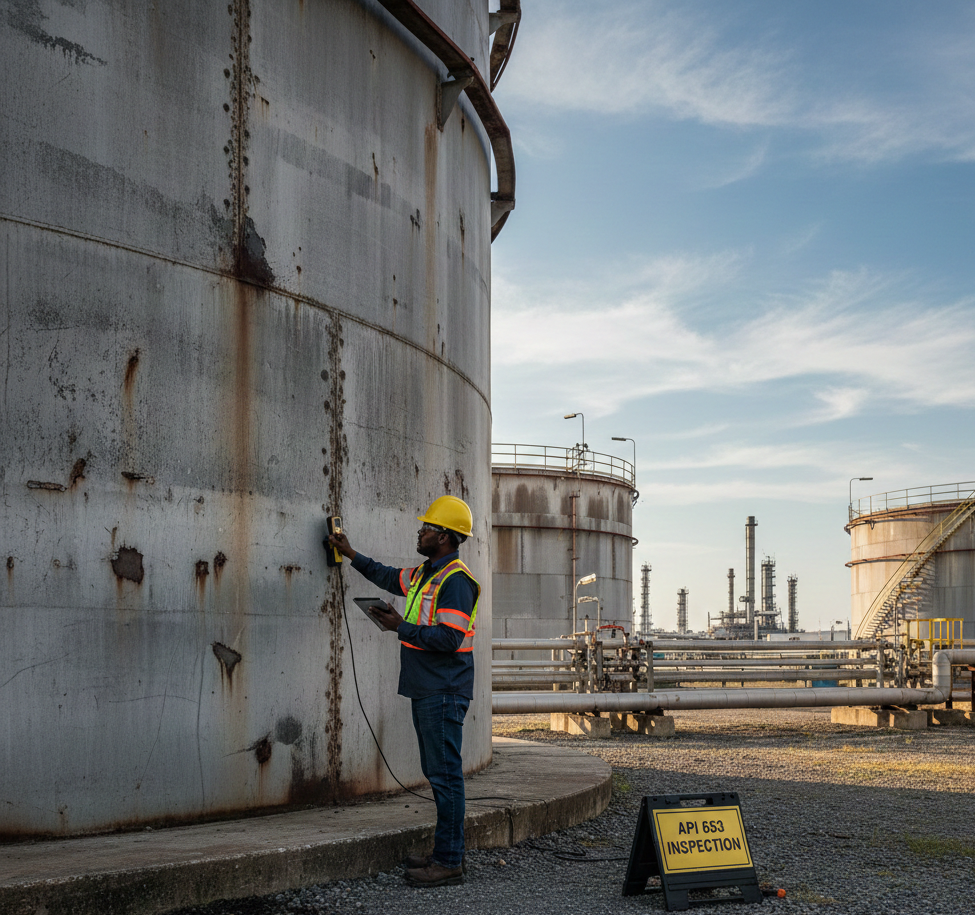

API 653 Aboveground Storage Tank Inspector
Course Description
This course prepares engineers and inspectors to apply API 653 for the inspection, repair, alteration, and reconstruction of aboveground storage tanks (ASTs). It bridges standard requirements with practical field techniques covering tank design features (per API 650), fitness for service concepts, corrosion mechanisms, NDE selections, settlement and shell evaluation, minimum thickness calculations, and repair methodologies. The program also incorporates exam preparation elements for the API 653 certification, including code navigation, problem-solving drills, and mock exams aligned with the Body of Knowledge.
The Training Course Will Highlight ?
Training Objective

By the end of the course, participants will be able to:

  • Understand the scope and applicability of API 653 for AST inspection and repairs.
  • Navigate and use API 653, API 650, API 571 (damage mechanisms), ASME Section IX (welding), and API 575 for inspection planning and execution.
  • Plan and conduct in-service, out-of-service, and hydrostatic test inspections; select appropriate NDE methods.
  • Perform minimum thickness, remaining life, corrosion rate, joint efficiency, and shell/roof/floor assessment calculations.
  • Evaluate settlement, foundations, nozzles, welds, annular plates, bottom plates, shell courses, and floating roof components.
  • Define and review repair/alteration plans, welding procedures (WPS/PQR), and documentation per compliance requirements.
  • Prepare effectively for the API 653 certification exam with structured practice.

Target Audience

  • Tank Inspectors (aspiring and practicing)
  • Mechanical/Rotating/Integrity/Corrosion Engineers
  • Maintenance & Reliability Engineers
  • Construction/Welding Supervisors and QA/QC personnel
  • Owner/Operator Representatives, HSE, and asset integrity teams in oil & gas, petrochemicals, terminals, power, and storage facilities

Prerequisites (recommended): Familiarity with API 650 design concepts, basic materials/welding knowledge, and plant safety practices. Prior exposure to NDE is beneficial.

Training Methods

  • Interactive lectures with code navigation and illustrated examples
  • Calculation workshops (thickness, remaining life, settlement, joint efficiency)
  • Case studies (floor corrosion, shell buckling, floating roof issues)
  • NDE demonstrations and procedure reviews (vendor neutral)
  • Daily quizzes and mock exam aligned to API 653 Body of Knowledge
  • Capstone exercise: Develop an inspection plan and repair package for a real‑world tank scenario

Daily Agenda

DAY 1

Fundamentals & Standard Framework

  • Tank types and configurations: fixed roof, internal/external floating roof, double deck, cone/umbrella roof, bottom/annular arrangements
  • API 653 scope & definitions; relationship with API 650, API 575, API 571, ASME IX
  • Inspection categories: routine, in-service, out-of-service, structural integrity checks, hydrotests
  • Documentation & records: inspection intervals, data requirements, jurisdictional considerations
  • Safety in tank inspection: confined space, inerting, gas testing, hot work permits
  • Workshop: Code navigation drills + interval determination scenarios
  • Quiz 1


DAY 2

Damage Mechanisms, NDE & In-Service Inspection

  • Corrosion mechanisms: underfloor corrosion, MIC, pitting, caustic embrittlement, SCC; environmental and product effects (API 571 overview)
  • NDE methods for ASTs: VT, UT (thickness & flaw detection), RT (selective), MT/PT, vacuum box testing, MFL for floors, leak testing methods
  • In‑service inspection planning: shell, roof, appurtenances, nozzles, manways, seals, sumps, vents, drains, gauging systems
  • Floating roof inspection: seal systems, pontoon integrity, rolling ladder/guide poles, rim fire risk, landing considerations
  • Workshop: NDE selection matrix + sample reports review
  • Quiz 2


DAY 3

Calculations: Thickness, Remaining Life, Stability & Settlement

  • Minimum required thickness calculations for shell, bottom plates, annular plates (including corrosion allowance)
  • Remaining life & corrosion rate; interval adjustments; RBI considerations
  • Joint efficiency & weld evaluation basics related to alteration/repair decisions
  • Hydrostatic test criteria, limits, and alternatives
  • Settlement evaluation: types (uniform, differential, edge, localized), measurements, acceptability criteria; shell plumbness and roundness
  • Roof evaluation: structural checks (rafters, girders), corrosion impacts
  • Workshop: Multi‑problem calculation set (shell thickness, floor corrosion mapping, settlement decision tree)
  • Quiz 3


DAY 4

Repairs, Alterations, Welding & Fitness-for-Service

  • Repair vs alteration vs reconstruction definitions; approval pathways and documentation
  • Floor repairs: patch plates, insert plates, annular ring replacement; bottom leak mitigation and coatings/liners overview
  • Shell repairs: insert plates, crack repairs, nozzle reinforcements, hot taps (risk considerations)
  • Roof repairs: fixed vs floating components; seal replacements, pontoon weld repairs
  • Welding requirements: WPS/PQR/WPQT; materials, preheat, PWHT considerations; qualifications per ASME IX
  • Fitness‑for‑Service concepts; when to invoke API 653 Appendix guidance or consult API 579
  • Workshop: Develop a repair package (drawings + WPS references + inspection hold points)
  • Quiz 4


DAY 5

Inspection Planning, Compliance, Mock Exam & Capstone

  • Building a comprehensive inspection plan: scope, sequence, isolation, cleaning, NDE, safety, access, documentation
  • Quality assurance & records: inspection reports, photos, isometrics/sketches, corrosion maps, checklists, traceability
  • Mock Exam: timed, code‑referenced; review of typical API 653 exam traps and quick lookup strategies
  • Capstone Exercise: Team presentation of inspection & repair strategy for a specified tank (incl. intervals, calculations, NDE plan, and risk notes)

AAR & Implementation Roadmap: Site rollout plan, interval scheduling, KPI tracking, and continuous improvement

Accreditation

CDGA attendance certificate will be issued to all attendees completing minimum of 75% of the total course duration

Quick Enquiry

Request Info

Download Brochure Request In house Proposal

Course Rounds : (5 -Days)


Code Date Venue Fees Register
MI270-01 08-02-2026 Amman USD 5450
MI270-02 18-05-2026 London USD 6950
MI270-03 06-09-2026 Dubai USD 5450
MI270-04 07-12-2026 Istanbul USD 5950
Prices doesn't include VAT

UpComing Date


Details
  • Start date 08-02-2026
  • End date 12-02-2026

Venue
  • Country Jordan
  • Venue Amman

Quality Policy

 Providing services with a high quality that are satisfying the requirements
 Appling the specifications and legalizations to ensure the quality of service.
 Best utilization of resources for continually improving the business activities.

Technical Team

CDGA keen to selects highly technical instructors based on professional field experience

Strengths and capabilities

Since CDGA was established, it considered a training partner for world class oil & gas institution

Search For Available Course

Ireland, Ireland

3012, Block 3, 30 Euro Business Park, Little Island, Co. Cork, T45 V220, Ireland

+353 214 552955

Mon to Fri 09:00 AM to 06:00 PM

Info@cdga-training.com

Contact Us anytime!